Other folks probably knew long ago what I recently discovered, but it’s still neat to learn something that’s new to me!
A personal pet peeve: Someone who acts as if he or she newly found something. Then with further examination this new discovery turns out to be of linear origin with roots going back decades or centuries. Miss Em and I toured south England going from garden to garden based on a premise that seemed to lean toward a ‘modernistic’ theme based on natural plantings and that were produced over the past 30 years.
I felt as if I was left to discover the links to prove or disprove this perspective. After a few months of adding books to my library and wearing my eyes out looking at online references, I believe that I found a pivot point. I don’t believe that I found an error in logic that produces an absurd outcome – a non sequitur which amounts to ‘a conclusion that does not logically follow.’ I believe I validated a ‘without which, not’ train of thought defined by the phrase sine qua non. I found the term ‘modern’ to be relative.
Without going through a litany of names of garden designers from the past century, I will take a stance that one person can be called the linchpin: William Robinson. He was born in Ireland in 1838 and lived to be 96-years old dying at Gravetye Manor, his estate near East Grinstead, England, in 1935. He wrote books and published magazines about gardening which supported his position about naturalistic planting. In his writings he didn’t hold back his dislike for formal garden design that ran counter to the norms of Victorian formal garden design.
He developed his point of view by taking what he learned in Ireland, adding to it at Regents Park, London, seeing how the French gardened during a stay in Paris, and finally touring the alps of France, Switzerland, and Italy where he concluded that alpine plants could be grown in England. He brought it all together after he returned to England and began editing first The Garden magazine followed by another magazine: Gardening Illustrated. He also travelled across the United States and to northern Africa which added to his perspectives.
Maybe 10-years ago while I enjoyed surfing through the index of Project Gutenberg digital books looking for free books to expand my knowledge of gardening, I discovered a booklet of 39 pages written by William Robinson in 1892. When I found Garden Design and Architect’s Gardens, I’d never heard of William Robinson but I downloaded it anyway. I later learned that Robinson was 54-years old when he wrote this booklet in reaction to the formal garden designs usually associated with Victorian gardens. His words didn’t pull any punches – at one point he called formal garden design ‘stupid.’
It wasn’t his first book and would not be his last. Arguably his best known book published in 1870 is The Wild Garden which focused on naturalistic plantings; Rick Darke, an American garden design consultant and photographer, added chapters with photographs to expand the 5th edition of 1895 into The Wild Garden: Expanded Edition published by Timber Press in 2009. Another of his books The English Flower Garden was published in 1883 with a reissue in 1984 of the 15th edition dating from 1933.

I found on my favorite online used book vendor a print-on-demand copy of Gravetye Manor: or Twenty years work in an old manor house, being an abstract from the Tree and Garden Book of Gravetye Manor, Sussex/kept by the owner William Robinson published by William Robinson in 1911. I thought I could download a free copy of the 150-plus pages from this book but that didn’t work out. I also found a copy of Mea Allan’s biography of Robinson: William Robinson (1838-1935): Father of the English Flower Garden (1982). I ordered both books and with the other books that I already have, perhaps I can put together a clearer picture in my mind of who Robinson was with the additional information from these two books.
Before Robinson bought Gravetye Manor in 1885, formal garden designers derisively called him an ‘armchair gardener.’ Over time as he put into practice the concepts about naturalistic plantings on the 1,000 acre estate, his influence grew. By the time of his death and beyond, his design principles could be found in the gardens of Gertrude Jekyl at Munstead Wood, Vita Sackville-West and Harold Nicholson at Sissinghurst Castle, Christopher Lloyd at Great Dixter, and Lawrence Johnson at Hidcote Manor among others.
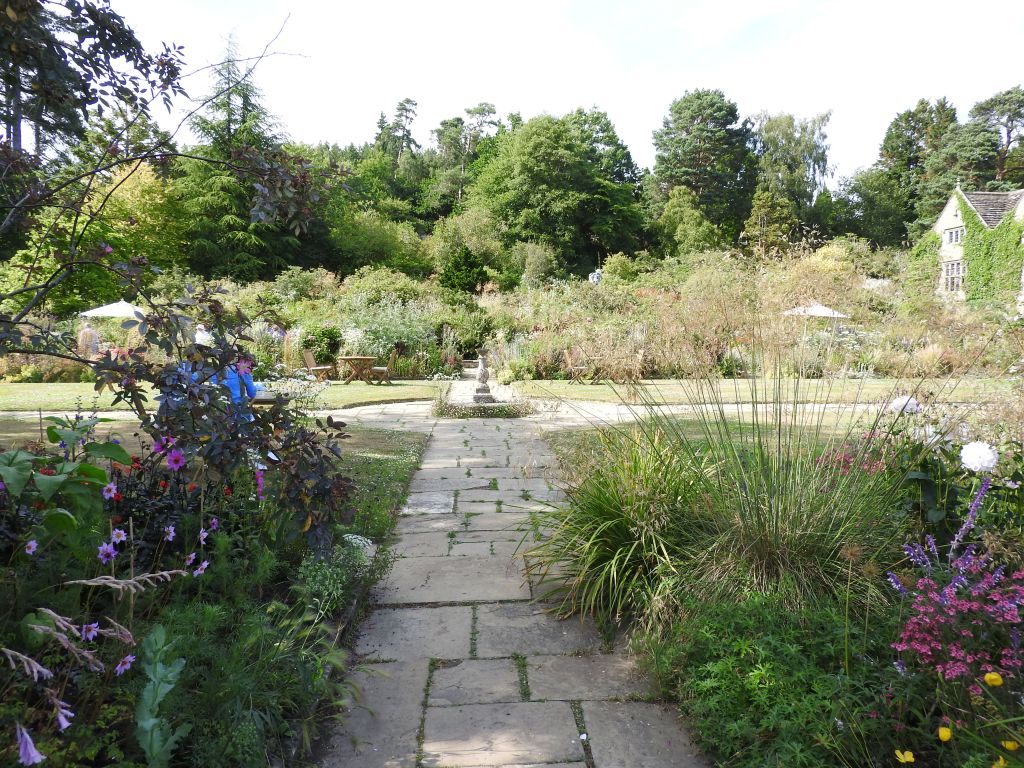
Robinson’s design principles centered on working with the lay of the land instead of imposing man-made features on a location. He disagreed with leveling the landscape around a house for the installation of planting beds to be planted with one kind of flowering plant in ‘bedding’ or ‘carpet’ gardens which was the norm during the Victorian era. Instead he wanted to see a blend of plants combined to make a natural look.
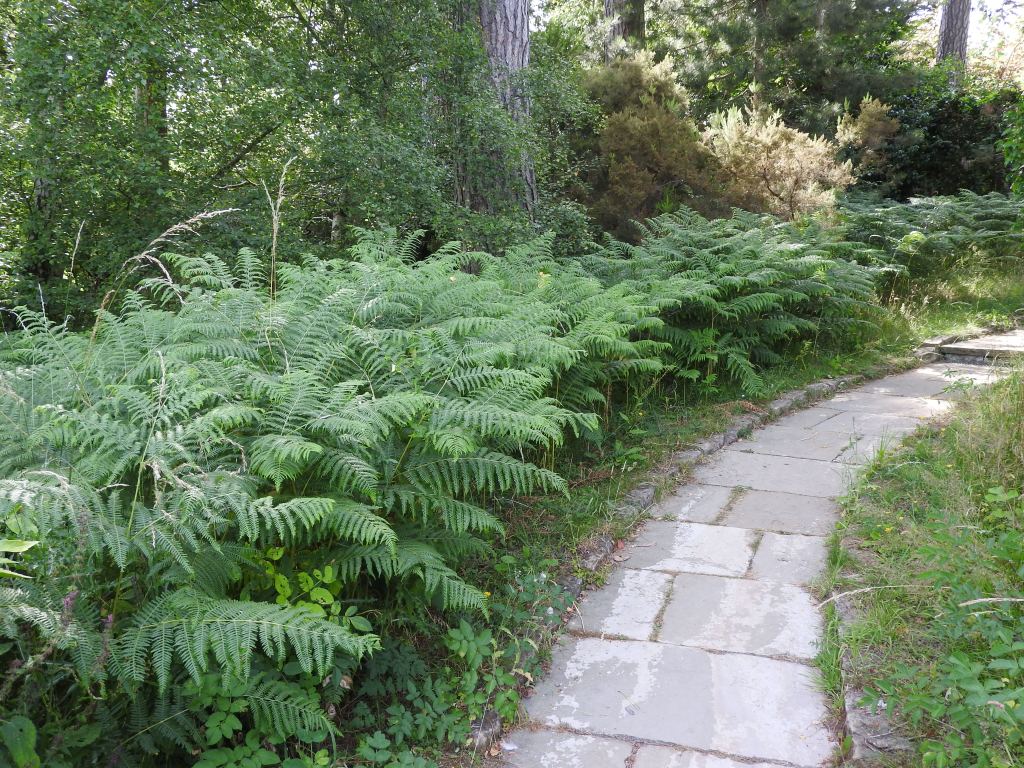
He considered any design to be good that worked with a site, its soil, and climate. He didn’t like plants that needed to be grown in a greenhouse and then planted in a bed. He preferred plants to be ‘hardy’ and able to thrive and survive on their own without a heavy investment of labor to maintain the garden. Essentially this perspective defined the terms of a ‘wild’ garden and ‘naturalistic’ planting. Perhaps his outlook as an adult started when as a child he had to carry water for plants growing in a greenhouse on the Irish estate where he lived.
After reading the books that I have on hand over the past few weeks, my appreciation of Robinson deepened. I still do not know as much as I would like about him but I reached one conclusion: He is the sine qua non of garden design for the past 180 years. Without him we might still be mired in a miasma of formal garden design.
©2022 James W. Humphreys. All rights reserved.
 Garden Where You Are